Are we still a nation of animal lovers? What our newest Empathy Index tells us
Are we a nation of animal lovers? In the UK, we like to describe ourselves as such on account of our high level of companion animal guardianship, estimated to be around 62% of households (Statista, 2026), and our history of comparatively strong animal welfare legislation (Animal Protection Index, 2020). However, this is quite a bold claim given the extent of animal use and abuse in all areas of our day-to-day lives, from what we eat to what we wear and what we enjoy for entertainment.
We found that 85% of UK adults describe themselves as “animal lovers”, indicating that the “nation of animal lovers” identity remains strong. Only 3% of people surveyed did not consider themselves to be an animal lover, while 13% remained indifferent – neither agreeing nor disagreeing that they are an animal lover.
At The Vegan Society, our goal is to promote a “way of living which seeks to exclude – as far as is possible and practicable – all forms of exploitation of, and cruelty to, animals for food, clothing or any other purpose” (The Vegan Society, 1988). This is our mission; this is who we are as vegans.
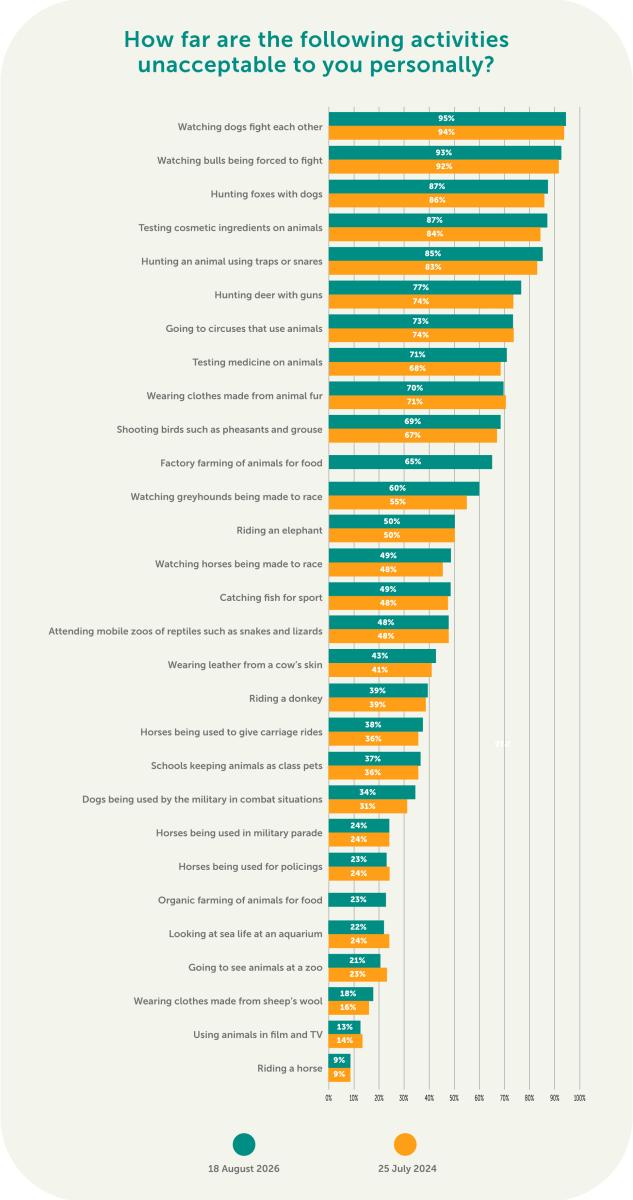
We wanted to know how the “nation of animal lovers” feels about some of the biggest forms of animal exploitation today. The various forms of animal use that we track in the Empathy Index have been selected to cover a range of animal exploitation, including food, clothing, cosmetics, entertainment and sport. This is by no means an exhaustive list – animal exploitation permeates throughout our society. The following graph visualises current attitudes towards animal exploitation, highlighting changes since 2024.
Shifting attitudes in the UK
The research revealed a few statistically significant changes between 2024 and 2026 that are worth highlighting.
Watching greyhounds being made to race was considered unacceptable by 55% of people surveyed in 2024. This rose to 60% in 2026, the most significant change in attitude recorded by the Empathy Index. Greyhound racing was banned in Wales and Scotland in 2026 after many long years of campaigning by activists. Greyhound racing is a cruel bloodsport causing death and injury to thousands of dogs every year. According to the RSPCA (2026), 4,399 dogs used in these races died and over 38,000 were injured between 2017 and 2025. These statistics are limited to injuries and deaths sustained on the track itself and therefore underestimate the total degree of death and suffering in the greyhound racing industry.
The suffering and deaths of greyhounds in racing are a consequence of viewing animals as disposable commodities that exist for our entertainment. The success of activists in Wales and Scotland has given greater momentum to achieve similar legislative change in England. A petition to ban greyhound racing in England, which closed in January 2026, gained over 55,000 signatures but drew a disappointing response from the government, which said that it has no plans to ban the cruel sport and considers it to be “well-regulated” and supporting the economy (UK Parliament and UK Government, 2026).
Many people have rescued or adopted greyhounds from the racing industry, providing them with the love and care they did not receive in their former lives. Sophia Amico is one such person. She adopted Roma in 2022: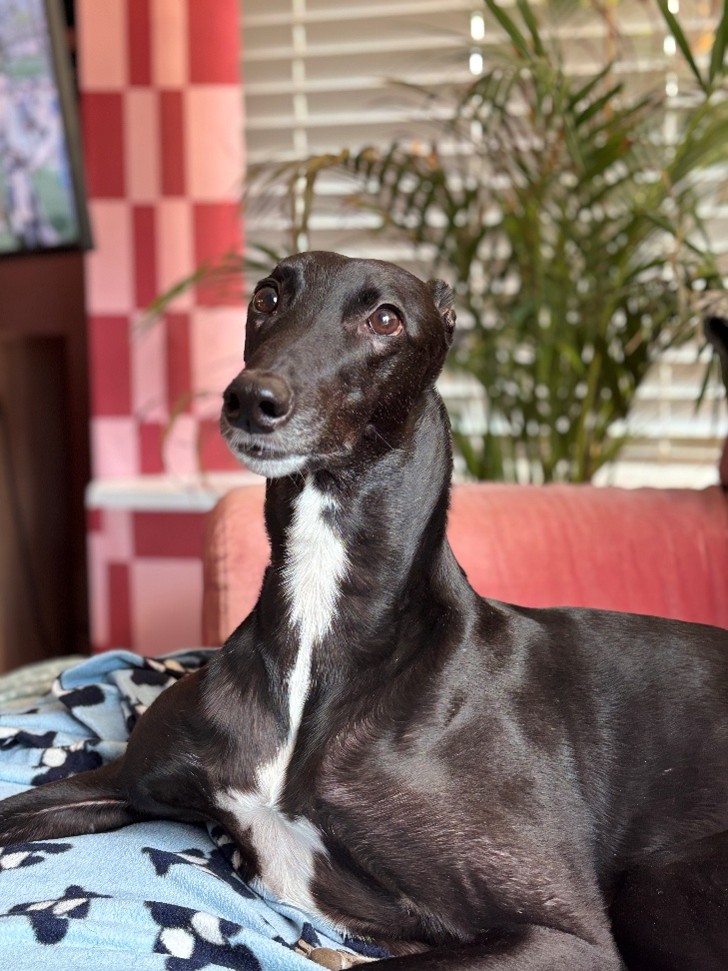
I like to think that meeting Roma was fate. We had seen a couple of greyhounds on a rehoming website and made the two-hour journey to meet them. Before we left, the trainer told us she had a couple of others who weren’t on the website yet if we wanted to meet them.
Roma trotted out, and I knew she was ours.
She came over and wrapped her arms around my boyfriend, and you could tell how desperately she wanted to be loved by humans. The trainer said she had had a difficult start in life. She had scars on her legs, the tip of her ear was missing, and her eyes were swollen, red and looked completely misshapen in her eye sockets.
Once we got her home, I reached out to the trainer to ask what was wrong with her eyes, and she said it was just ‘kennel dust’ and that she had been seen by a vet. I asked for her vet record and was told she didn’t have one. She said she was just checked out by a vet ‘in the car park after a race’ – nothing official.
We took her to an eye specialist, and she was diagnosed with autoimmune disease of the eye and would require lifelong medication. I was shocked. How could someone leave a dog like that? Let alone force them to race. It was heartbreaking.
Four and a half years after rescuing her, her eyes have cleared for the most part. She’s had her challenges with sleep startle and reactivity with other dogs, but she’s the funniest, goofiest, sweetest dog ever.
It is crazy to think that at one point, she was worthless to the racing industry, but to us, she’s the most precious thing in our lives. She’s the centre of our world.
Another shift in attitudes worth highlighting is towards testing cosmetic ingredients on animals. We found that 87% of respondents were opposed to animal testing for cosmetics, up from 84% in 2024 – a statistically significant change. When looking just at female respondents, those who consider testing cosmetic ingredients on animals to be unacceptable rose to 90%. Those who consider testing medicine on animals to be unacceptable is now 71%. It is, however, currently required by international regulations in almost all circumstances.
Animal testing is a cruel and unnecessary practice that has received a lot of attention in recent years. Millions of experiments are conducted on animals annually around the world, including 2.54 million procedures on animals in the UK in 2025 (Home Office, 2026). In 2025, the UK government announced an animal-testing roadmap setting out plans for phasing out animal testing and for investment in alternatives. Animal testing remains one of the least popular forms of animal use in the UK for good reason. However, we must also acknowledge that many cosmetic products marketed as ‘cruelty-free’ still contain animal products. Many common ingredients found in cosmetic products can be animal derived, such as collagen, keratin, oestrogen and beeswax (The Vegan Society, 2023).
Hunting deer is somewhat or completely unacceptable to 77% of people in the UK, a significant increase from 74% in 2024. In fact, most forms of hunting measured in the Empathy Index are considered unacceptable by the majority. Hunting foxes with dogs is considered unacceptable by 87% of people, using snares or traps by 85% and shooting birds such as pheasants or grouse by 69%. Over 60 million of these birds are released for shooting each year in the UK countryside (League Against Cruel Sports, 2026).
Most of the significant shifts between 2024 and 2026 have been positive, however, we recorded a statistically significant rise in people in the UK finding it acceptable to go see animals at the zoo, which grew to 79%, up from 77% in 2024.
How do people feel about farming?
This year, we added two additional forms of animal use and exploitation in animal farming to our Empathy Index. We found that factory farming of animals for food is unacceptable to 65% of the UK population, while organic farming of animals for food is unacceptable to 23%. These two forms of animal farming have been used as examples to gauge public opinion but do not fully capture all forms of animal farming. Our data closely resembles the findings from Project Phoenix’s recent research into current attitudes of the British public on factory farming, which found that 67% of UK adults believe factory farming to be morally wrong or concerning (Project Phoenix, 2026).
These findings are more striking when we recognise that 82% of the sample are meat-eaters. We know from Project Phoenix’s research that most people in the UK fundamentally misunderstand animal farming. According to Project Phoenix (2026), 96% of the UK population either do not know how many animals are factory farmed, or underestimate the scale of it.
The truth is that in the UK, 85% of farmed animals are factory farmed, making factory farming the most common form of animal farming in the UK by a wide margin (Compassion in World Farming, 2023). Globally, according to Our World in Data (2023), “More than 100 billion animals are killed for meat and other animal products every year.” The scale of exploitation and suffering is unlike any other measured in the Empathy Index.
What do people accept the least?
The top three least acceptable forms of animal use, according to the Empathy Index, are watching dogs fight each other, watching bulls being forced to fight and hunting foxes with dogs. It’s worth acknowledging that all three of these are illegal in the UK, with bullfighting having no history in this country. However, hunting foxes with dogs was not always so unpopular. This level of opposition is the direct result of many years of campaigning against fox hunting in the UK, which was banned in Scotland in 2002 and in England and Wales in 2005. The ban is poorly enforced, and “trail hunting” – using hunting dogs to follow an artificial scent – emerged as a cover for hunters to continue fox hunting (League Against Cruel Sports, 2026). However, trail hunting is also due to be banned in England and Wales following a public consultation.
What do people accept the most?
The three forms of animal use considered most acceptable in the UK, according to the Empathy Index, are riding a horse, using animals in film and TV and wearing clothes made from sheep’s wool.
The purpose of the Empathy Index is to track public attitudes to animal uses over time, highlighting how views change regarding animal cruelty, as well as revealing some areas where views can be contradictory. The forms of animal use that we track in the Empathy Index are not all the same; some cause much greater suffering than others. However, we want to challenge the idea that animals exist to satisfy the needs and wants of humans.
We want to challenge the idea that animals exist to satisfy the needs and wants of humans. Many of these forms of animal use are possible to avoid and vegans will do this as far as possible, not riding horses, using animals for entertainment or wearing their coats. We hope that our research both helps advocates encourage a shift toward greater compassion and people to consider choosing to be vegan and live in harmony with nature, our fellow animals and their values.
Behind the research
Our Empathy Index provides a fresh insight into the attitudes of the UK population on what forms of animal use they consider acceptable. This index was created from the results of a survey of 2000 UK adults, using nationally representative targeting*. Respondents were shown 29 different statements on animal use and asked the following question, “How far are the following activities acceptable or unacceptable to you personally?” A four-point answer scale was employed from “completely acceptable” to “completely unacceptable”.
This is the second wave of the Empathy Index. The first was conducted in 2024 using the same methodology.
Using the Empathy Index
It is our hope that we can collectively move the dial in a positive direction on animal use of all kinds so that no animals are made to suffer at human hands. Our Empathy Index can be used by researchers or animal advocates as a measurement of attitudes in the “nation of animal lovers”.
If you have any questions about the Empathy Index, please get in touch with our research team at research[at]vegansociety[dot]com.
*National representative targeting 2000 UK adults.
Age:
- 18 – 24: 11%
- 25 – 34: 17%
- 35 – 44: 16%
- 45 – 54: 17%
- 55 – 64: 16%
- 65+: 23%
Gender:
- Male: 49%
- Female: 51%
Home Region:
- East Midlands: 8%
- East of England: 9%
- London: 13%
- North East: 5%
- North West: 12%
- Scotland: 8%
- South East: 13%
- South West: 9%
- Wales: 5%
- West Midlands: 9%
- Yorkshire & Humber: 9%